5 Connection Blockers: Why Your Prayer Feels Stuck
I can't tell you how to feel connected when you pray. I can show you the five things most likely blocking the line.

I don’t feel connected during my prayers.
I can’t have intention during my tefillah.
I hear this all the time, usually followed by a request for advice. The honest answer is that I can’t give you a formula. Prayer is one of the most personal things a person does, and what opens it up for me might do nothing for you.
What I can do is name the blockers. These are five things that, with high probability, are getting in the way. Remove them, and the connection has room to show up.
Blocker #1: Thinking God needs your prayers
Right off the bat: please don’t walk in as if you’re doing Hashem a favor.
Iyov asks it bluntly:
Yes, Hashem is like our Father, and He wants the connection. The Gemara even says “the Holy One, Blessed be He, desires the prayers of the righteous” (Yevamot 64a). But wanting is different from needing. A father wants to hear from his kids. He doesn’t need their phone call to pay his rent.
So if anything, prayer is a gift to us. It’s a merit, an open line we get to pick up.
Now look at how we usually show up. Guilt. Shame. A sense of distance. Prayer as a chore we unload so we can move on with the day. Start from that place and the prayer is off on the wrong foot before Baruch Atah even leaves your mouth.
The shift: Walk in thinking opportunity. You are the one who walks out richer.
Blocker #2: Drowning in quantity
Prayer can be overwhelming, and Jewish prayer especially. Pick up a siddur. It’s thick. Some mornings we feel like we have to finish it cover to cover and say every single word, at speed, or we failed.

The Shulchan Aruch, the code of Jewish law, settles it in the first chapter:
Quality over quantity. That’s the halacha.
Yes, some prayers are obligatory, and nobody is telling you to skip them. But compare the obligatory core to the whole siddur and it’s a lot smaller than most people think.
The shift: If you feel overloaded, sit down with a rabbi you trust. Ask him to show you what’s required and what’s optional. Then build from quality, and let the page count grow with it.
Blocker #3: Distractions, outside and inside
Oh boy, are there distractions.
Outside: the phone on the table, a messy room, sitting where something keeps catching your eye. Be intentional about your setting.

The Mishnah sets the bar for focus high: “even if the king greets him, he should not respond to him, and even if a snake wraps around his heel, he should not interrupt” (Berachot 5:1). Most of us get knocked off course by a buzz.
Inside, and this one matters more: what were you doing right before you prayed?
If the last ten minutes were news updates, messages, and everything else that runs the gamut on our phones, your mind is an echo chamber. It replays what it just saw. You say Shema, and your head says that headline.

The Rambam describes real intention as clearing the room first: “One should clear his mind from all thoughts and envision himself as standing before the Divine Presence” (Hilchot Tefillah 4:16).
The shift: Block the inputs before you pray, so there’s less in your head to drift back to. Then take a few deep breaths and let your mind settle. Less noise in, more connection out.
Blocker #4: Showing up as an empty vessel
How many times do we show up to pray with a blank sheet in our head?
Preparation is huge. Think about it: if I know what I’m going to ask for, and I know what I’m going to thank God for, I have something to aim at. Telling myself don’t get distracted is hard. Pointing my mind toward something is much easier.
The prophet Amos says it in four Hebrew words: hikon likrat Elokecha Yisrael, “Prepare to meet your God, O Israel” (Amos 4:12). The Gemara (Shabbat 10a) quotes that verse for how the sages got themselves ready for prayer. Preparation is part of the prayer.
That’s why the order matters. First remove the distractions (Blocker #3). Then fill the space with what you actually came to say.
The shift: Keep a list. A short one is fine: two things you need, one thing you’re grateful for, one person you’re carrying. With a list in hand, focus stops being a fight.
Blocker #5: Asking without a “why”
This one goes a little deeper.
We ask for things. We ask for money. We ask for better relationships. We ask for health. And we leave it there.
What’s the blocker? We believe we were created as partners with Hashem in His mission for the world. The Gemara uses that exact language: a judge who rules truthfully, even for one hour, is considered “a partner to the Holy One, Blessed be He, in the act of Creation” (Shabbat 10a). If that’s who we are, shouldn’t our requests say what the partnership is for?
So add four words: so that I can.
- Hashem, please give me more money, so that I can…
- Hashem, help my relationship get better, so that I can…
Fill in the blank. When the answer ties back to the bigger mission, look at how much more connected the prayer becomes. Someone asking for wealth so he can help the less fortunate, build something lasting, or do something in line with God’s plan is praying a very different prayer from someone who just wants a bigger number in the bank.
Pirkei Avot puts the same idea as a rule for life: “All of your actions should be for the sake of Heaven” (Avot 2:12). So that I can brings that rule into your requests.
Four words turn a wish list into a mission statement: “So that I can.”
Five blockers, one place to start
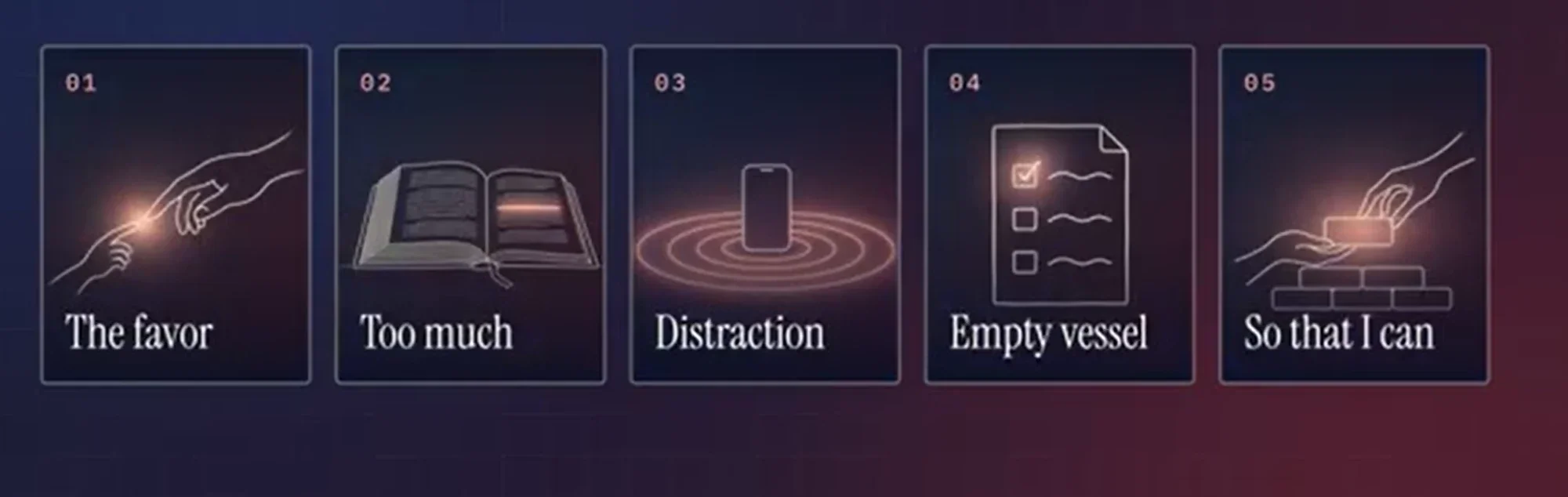
- The favor. Showing up as if God needs it.
- Too much. Page count over presence.
- Distraction. The phone on the table and the echo in your head.
- Empty vessel. No list, nothing to aim at.
- So that I can. Asking without saying what it’s for.
There are many more. These are the five I see most often. Pick the one that hit closest, and work on it this week.
And if you have a blocker of your own, please share it. Someone else is probably stuck on the same one.
English quotes follow Sefaria’s translations: JPS for Iyov and Mishlei, the William Davidson edition for the Talmud, Open Mishnah for Berachot and Avot, and Eliyahu Touger for the Rambam.


